












How Roamvy Chooses Local Networks in Each Country
Jan. 28, 2026
Roamvy
Most travelers assume mobile connectivity is simple: you buy a SIM, connect to one carrier, and hope for the best. In reality, network performance varies dramatically by city, region, time of day, and even weather conditions. This is why many travelers today compare international eSIM providers before choosing one that can handle real-world travel conditions.
Roamvy is built around a different philosophy.
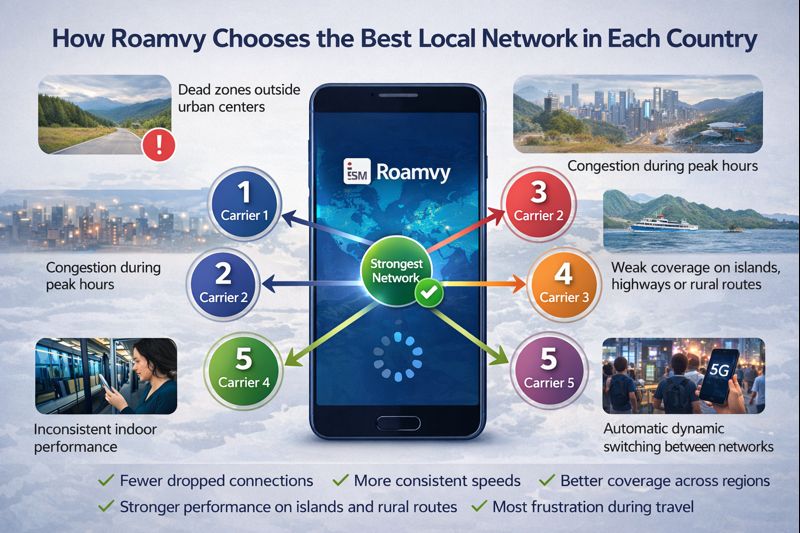
Instead of relying on a single carrier in each country, Roamvy dynamically connects travelers to multiple local networks, selecting the best available option in real time. This approach delivers stronger coverage, more consistent speeds, and fewer dropped connections, especially when traveling across regions.
This guide explains how Roamvy chooses local networks, why it matters, and how it directly improves your travel experience.
Why Single-Network SIMs Often Fail Travelers
Traditional local SIM cards and many global roaming solutions rely on one primary carrier per country. While this can work in major cities, it often breaks down when travelers move beyond predictable areas.
Common problems with single-network SIMs include:
- Dead zones outside urban centers
- Congestion during peak hours
- Weak coverage on islands, highways, or rural routes
- No fallback if the primary network degrades
- Inconsistent indoor performance
Travelers experience this as slow data, dropped connections, or complete service loss even when other nearby networks are functioning normally.
Roamvy’s Multi-Network Connectivity Model
Roamvy uses a multi-network model rather than locking users to a single carrier.
In each country, Roamvy maintains agreements with multiple Tier-1 and Tier-2 local operators. Your device is not permanently assigned to one network — instead, it can access several networks. This architecture supports international data eSIM unlimited usage by focusing on stability and availability rather than just raw speed..
This allows Roamvy to prioritize:
- Coverage first
- Stability second
- Speed third
For travelers, this hierarchy matters more than peak speed alone.
How Network Selection Works in Practice
When you arrive in a new country, Roamvy does not simply attach you to the first available carrier. Instead, your eSIM evaluates multiple factors before selecting a network.
These include:
- Signal strength at your location
- Network congestion levels
- Available LTE or 5G coverage
- Device compatibility
- Regional performance history
Your phone then connects to the strongest available partner network — and can switch if conditions change.
Your phone then connects to the strongest available partner network — and can switch if conditions change. This process is automatic and continuous, whether you’re managing your plan from the Roamvy dashboard or through the Roamvy app Android users rely on for quick setup and monitoring.
Dynamic Switching as You Travel
Connectivity conditions change constantly while traveling.
- You move from the city to the countryside
- You board a train or ferry
- You enter a dense urban core
- A network becomes congested during peak hours
Roamvy allows your device to switch between partner networks when performance drops — something single-carrier SIMs cannot do.
This is especially valuable in:
- Island destinations
- Mountain regions
- Road trips
- Multi-city itineraries
- Large festivals or events
Instead of losing service, your device transitions to a better-performing network.
Why This Matters More Abroad Than at Home
At home, most users remain within a small geographic area and on a familiar network. Abroad, travelers are constantly moving — often across unfamiliar and uneven infrastructure.
International connectivity adds additional complexity:
- Roaming agreements vary by region
- Not all networks treat roaming traffic equally
- Congestion affects roaming users first
- Fallback options are limited on single-carrier plans
Roamvy’s multi-network design reduces these risks by ensuring alternatives are available.
Real-World Travel Scenarios Where This Makes a Difference
Island Travel
In destinations like Greece, Indonesia, or Spain’s islands, coverage can vary sharply between carriers. Roamvy selects the network with the strongest island-specific infrastructure.
Rural Routes
On road trips through countryside regions, Roamvy shifts to carriers with better rural tower density.
Urban Congestion
During peak hours in cities, Roamvy can switch to alternative networks to maintain speed and stability.
Cross-Border Travel
For regional plans, Roamvy seamlessly transitions between countries without requiring manual SIM changes or connectivity interruptions.
LTE and 5G Optimization
Roamvy does not aggressively force 5G if it reduces reliability.
Instead:
- LTE is prioritized when it offers stronger coverage
- 5G is used when it is stable and beneficial
- Your device automatically selects the best option
This prevents battery drain, connection drops, and unnecessary speed fluctuations — common complaints with unmanaged 5G roaming.
Manual Network Selection (When Needed)
Advanced users can manually select networks from their phone settings if desired. However, Roamvy recommends keeping automatic network selection enabled, as it allows the system to respond dynamically to changing conditions.
Manual selection is useful only in rare cases when a traveler wants to temporarily lock onto a specific carrier.
How This Improves the Roamvy Experience
Roamvy’s network selection strategy results in:
- Fewer dropped connections
- More consistent speeds
- Better coverage across regions
- Stronger performance on islands and rural routes
- Less frustration during travel
Most importantly, it removes the need for travelers to understand or manage carrier complexity themselves, even when using an international data eSIM unlimited plan across multiple countries.
FAQs
Does Roamvy use only one carrier per country?
No. Roamvy connects to multiple local networks and selects the best available option.
Will my phone automatically switch networks?
Yes. Switching happens automatically when conditions change.
Can I manually choose a network?
Yes, but automatic selection is recommended for best performance.
Does this affect data speed?
Yes. It improves stability and often results in better real-world speeds.
Is this available on all Roamvy plans?
Yes. Multi-network access is a core part of Roamvy’s connectivity model.