












LTE vs 5G Abroad: What Travelers Actually Experience
Jan. 27, 2026
Travel Lifestyle & Tips
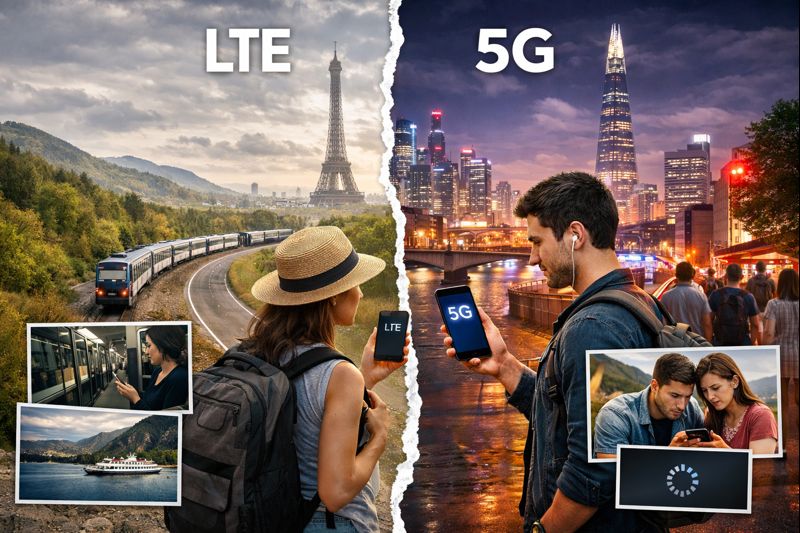
Mobile carriers heavily market 5G as the future of connectivity — promising ultra-fast speeds, low latency, and seamless performance everywhere. But once travelers leave their home country, the reality of 5G often looks very different.
If you’ve ever landed abroad, seen a “5G” icon on your phone, and still experienced slow or unstable data, you’re not alone.
This guide explains what travelers actually experience with LTE and 5G abroad, why LTE still dominates international travel connectivity, and how eSIMs for international travel help users stay reliably connected across borders.
Why the LTE vs 5G Question Matters for Travelers
When traveling, mobile data is not just about speed — it’s about consistency, coverage, and reliability.
Travelers depend on mobile data for:
- Navigation and ride-hailing
- Digital tickets and boarding passes
- Translation and maps
- Messaging and video calls
- Emergency communication
A fast but unstable connection can be worse than a slower, consistent one. This is why many travelers prefer international esim data plans that prioritize coverage and stability over peak speeds.
What 5G Really Means Outside Your Home Country
5G is not a single global standard. Its availability and performance vary widely depending on:
- Country-level infrastructure investment
- Carrier rollout strategy
- Spectrum allocation
- Urban density
- Device compatibility
In many destinations, 5G is available only in limited urban areas, while LTE remains the backbone of national coverage.
The Reality of 5G Abroad
Major Cities
In large global cities (London, Paris, Tokyo, Seoul, New York):
- 5G speeds can be excellent
- Performance is strongest outdoors
- Indoor coverage may drop back to LTE
- Congestion during peak hours is common
5G works best when conditions are ideal — but those conditions aren’t always present while traveling.
Medium Cities & Tourist Areas
In popular tourist destinations:
- 5G may appear briefly, then disappear
- Phones often switch between 5G and LTE
- Speed gains are inconsistent
This switching can increase battery drain and reduce reliability — even on an unlimited esim data plan.
This constant switching can cause:
- Higher battery drain
- Short data interruptions
- Reduced reliability
Rural Areas & Transit Routes
On highways, trains, ferries, and countryside routes:
- 5G is rarely available
- LTE dominates
- LTE offers more stable handoffs between towers
For most intercity travel, LTE provides a better overall experience.
What Travelers Actually Experience with LTE Abroad
LTE (also known as 4G or 4G+) remains the most reliable global standard for esims for international travel.
Across most countries, LTE offers:
- Broader national coverage
- Better signal penetration indoors
- Smoother handoffs between towers
- More predictable speeds
Even travelers using an unlimited esim data plan often find LTE more dependable than inconsistent 5G signals.
Real-World Speed Comparison (Travel Scenarios)
|
Scenario |
LTE Experience |
5G Experience |
|
City center |
20–80 Mbps |
100–300 Mbps |
|
Metro/subway |
Stable |
Drops frequently |
|
Trains & highways |
Reliable |
Rare or unavailable |
|
Rural towns |
Usable |
Usually unavailable |
|
Battery usage |
Moderate |
High |
|
Video calls |
Stable |
Can fluctuate |
For navigation, messaging, calls, and work, LTE is more than sufficient.
Why LTE Often Feels “Better” While Traveling
Several technical reasons explain why travelers often prefer LTE abroad:
1. Coverage Density
LTE networks have been deployed for over a decade and cover more territory than 5 G networks.
2. Signal Penetration
LTE travels farther and penetrates buildings better than high-frequency 5G signals.
3. Network Stability
LTE handles movement (trains, cars, ferries) better than early-stage 5G networks.
4. Lower Battery Drain
5G radios consume more power, especially when switching frequently between networks.
When 5G Is Actually Worth Using Abroad
5G makes sense when:
- You are in a major city
- You need very high speeds (large uploads, hotspot use)
- Coverage is stable and continuous
- Battery life is not a concern
In many destinations, 5G coverage is limited to select city zones, while LTE remains the backbone of most international eSIM data plans used by travelers.
When You Should Force LTE Instead
Many experienced travelers manually switch to LTE when:
- Data feels unstable
- The battery drains quickly
- They are moving between locations
- They are in rural or island regions
Forcing LTE often results in:
- More consistent speeds
- Fewer dropouts
- Longer battery life
This is especially useful on longer trips.
How Roamvy Optimizes LTE and 5G Abroad
Roamvy eSIMs are designed to:
- Connect to multiple local carriers, not just one
- Automatically select the strongest available network
- Prioritize stability over peak speed
This means:
- LTE is used when it offers better reliability
- 5G is used when it’s truly beneficial
- Your device switches intelligently without manual input
The result is a smoother travel experience across regions.
Common Misconceptions About 5G Abroad
“5G always uses more data.”
False. Data usage depends on activity, not network type.
“If my phone shows 5G, it’s the fastest option.”
Not always — signal quality matters more than the label.
“LTE is outdated.”
LTE remains the global standard for mobile travel.
FAQs
Is LTE slower than 5G?
Yes, in peak conditions, but LTE is often more consistent while traveling.
Will I miss out by disabling 5G?
No. Most travel activities work perfectly on LTE.
Does Roamvy support both LTE and 5G?
Yes. Roamvy supports LTE and 5G across its international esim data plans.
Should I force LTE on long trips?
Often yes, especially outside major cities.
Does 5G work in islands or rural areas?
Rarely. LTE is far more reliable in those regions.